

What Is Melanoma? Understanding the Basics of Skin Cancer
What Is Melanoma? Understanding the Basics of Skin Cancer
March 26, 2026 by adminNobody really sits down and thinks about their skin not until something changes. A spot that wasn’t there before. A mole that looks a little different from how it did last year. Most of the time, people notice these things and do nothing. They tell themselves it’s probably nothing. They wait. And in many cases, that waiting is exactly where the real problem begins. Melanoma is not a dramatic disease that announces itself loudly. It starts small, looks ordinary, and moves quietly which is precisely what makes understanding it so important. If you’ve been brushing off something on your skin, speaking to the Best Oncologists In Chennai, at Sugam Hospital is the one step worth taking sooner rather than later.
It Starts With a Cell
To understand melanoma, you have to understand where it comes from.
Deep within the layers of your skin sit cells called melanocytes. Their primary function is to produce melanin, the pigment that determines skin colour and also acts as the body’s first line of defence against UV radiation. These cells are not passive. They respond to sunlight, they communicate with surrounding tissue, and under normal conditions, they divide and replace themselves in a tightly regulated way.
The problem begins when the DNA inside a melanocyte gets damaged. This damage disrupts the signals that tell cells when to grow and when to stop. A cell that should divide once and settle quietly instead keeps dividing unchecked, unregulated, and increasingly abnormal. Over time, this accumulation of abnormal cells becomes a tumour. That tumour, sitting in the skin, is melanoma.
What separates melanoma from most other skin cancers isn’t where it starts. It’s what it does next. Left undetected, melanoma doesn’t stay put. It travels through the lymphatic system and the bloodstream reaching the lungs, liver, brain, and bones. That capacity to spread is what gives melanoma its clinical weight and why a diagnosis at Stage I and a diagnosis at Stage IV are worlds apart in terms of what treatment looks like and what outcomes are realistic.
The Different Faces of Melanoma
One reason melanoma is missed so often is that people imagine it looks a specific way, a dark, obviously suspicious patch of skin. The reality is considerably more varied.
Superficial spreading melanoma is the most common type. It tends to grow outward across the skin surface before it grows downward, which means there’s often a visible window of time where it can be caught before it penetrates deeper layers. It frequently appears as a flat or slightly raised discoloured patch with uneven borders and mixed colouring.
Nodular melanoma is more aggressive. It grows downward quickly, often appearing as a raised bump that may be black, red, pink, or even skin-coloured. It doesn’t follow the typical appearance people associate with skin cancer, which makes it easier to dismiss as a harmless cyst or irritated follicle.
Lentigo maligna melanoma develops slowly, typically on the face or other chronically sun-exposed areas, and often in older adults. It may look like a large, flat freckle for years before it becomes invasive.
Acral lentiginous melanoma appears on the palms, soles of the feet, and under the nails and is disproportionately seen in people with darker skin tones. In India, this type is particularly underdiagnosed because of the persistent belief that melanin-rich skin is immune to skin cancer. It is not. Melanin offers partial protection not complete protection and this distinction matters enormously.
Recognising What Doesn’t Look Right
You don’t need a medical degree to notice when something on your skin has changed. The ABCDE framework exists precisely for this reason, it gives anyone a practical, reliable way to evaluate a mole or skin lesion.
Asymmetry: If you drew a line through the centre of a mole and both halves looked different, that’s asymmetry worth noting.
Border: healthy moles have clean, defined edges. Blurred, jagged, or irregular borders are not typical.
Colour : a single mole showing multiple shades browns, blacks, reds, or patches of white is displaying colour variation that warrants attention.
Diameter: anything wider than six millimetres, roughly the size of a pencil eraser, should be examined professionally.
Evolving: this is the one that carries the most weight any change in a mole over weeks or months, whether in size, shape, colour, texture, or sensation, is a reason to act.
These markers don’t diagnose melanoma. They flag the need for a proper clinical evaluation. That’s their purpose, and it’s a genuinely useful one.
Who Needs to Pay Closer Attention
Some people carry a higher baseline risk, and knowing that changes how proactively you should be monitoring your skin.
A personal or family history of melanoma raises the risk meaningfully, certain inherited gene mutations run through families and increase susceptibility across generations. People with a large number of moles, or moles that are unusually shaped or sized, face higher risk. A history of severe sunburns particularly those that occurred in childhood, has been linked to increased lifetime melanoma risk even decades later. People with weakened immune systems, whether from illness or long-term medication, have reduced ability to identify and eliminate abnormal cells before they develop further.
Being in a higher-risk group doesn’t mean melanoma is inevitable. It means regular monitoring stops being optional and becomes genuinely important.
What Diagnosis and Staging Actually Involve
When a skin lesion raises concern, the evaluation process is straightforward and not as intimidating as many people expect.
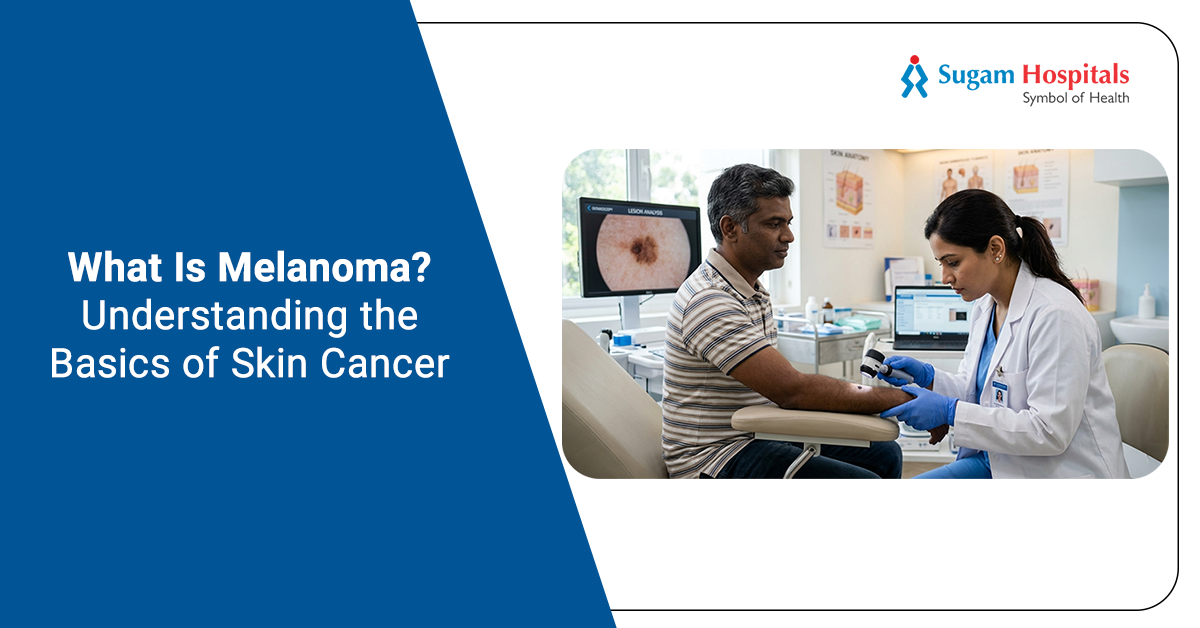
A dermatologist or oncologist will begin with a visual examination, often using dermoscopy — a handheld instrument that illuminates and magnifies the skin’s subsurface structures in ways the naked eye cannot. If the lesion looks suspicious, a biopsy follows. A small amount of tissue is removed under local anaesthetic and sent for microscopic analysis. The result confirms whether melanoma is present and identifies the cell type.
Staging follows a confirmed diagnosis. It runs from Stage 0 where abnormal cells are confined entirely to the skin’s outermost layer through to Stage IV, where the cancer has spread to distant organs. The treatment path, and the outlook, differ significantly depending on the stage.Stage I melanoma carries a five-year survival rate above 98%. That number falls considerably at Stage IV. The distance between those outcomes is not luck, it is timing.
Treatment Has Moved Forward Significantly
Surgery remains the primary treatment for early-stage melanoma, removing the tumour along with a clear margin of surrounding tissue to ensure no abnormal cells are left behind. For advanced stages, the treatment landscape has changed considerably over the past decade.
Immunotherapy has been the most significant development. Rather than directly targeting cancer cells, it works by releasing the brakes on the immune system allowing it to recognise and attack melanoma cells with a specificity that earlier treatments simply couldn’t achieve. Targeted therapy takes a different approach, identifying specific genetic mutations within the tumour and blocking the molecular pathways that allow it to survive and grow. For appropriate cases, these two approaches are sometimes combined.
The honest truth about melanoma treatment is this: it works best when there is less disease to treat. Every stage earlier a diagnosis is made expands the options available and improves the outcome.
At Sugam Hospital’s Department of Oncology, we understand that walking in with a skin concern takes a certain kind of courage. There’s the fear of what you might find out. There’s the uncertainty of not knowing what to expect. Our Oncologists are here to make that process clear, thorough, and deeply human because a cancer concern isn’t only a clinical matter. It carries real weight, real worry, and the very human need to be taken seriously.
If something on your skin has changed, or if you simply haven’t had a proper check in years, now is the right time. Melanoma is one of the few cancers where the window between early and late makes an enormous difference. Don’t let that window close.