

How Blood Cancers Develop in the Body
How Blood Cancers Develop in the Body
March 30, 2026 by adminMost people understand cancer in fairly visual terms a lump, a growth, something that shows up on a scan and can be pointed to. Blood cancer does not work that way. There is no solid tumor to locate, no mass pressing against an organ, no obvious physical landmark that marks the starting point. It develops quietly, within the blood-forming system itself, and by the time symptoms become noticeable enough to act on, the disease has often been progressing for longer than anyone realized. Understanding how blood cancers actually develop the biological sequence of events that leads from a normal cell to a cancerous one is not just medically interesting. It is genuinely useful for anyone trying to make sense of a diagnosis or understand why early detection matters as much as it does. At Sugam Hospital, a trusted cancer hospital in Chennai, we believe that informed patients navigate their care better. This is where that understanding starts.
Where Blood Cells Come From
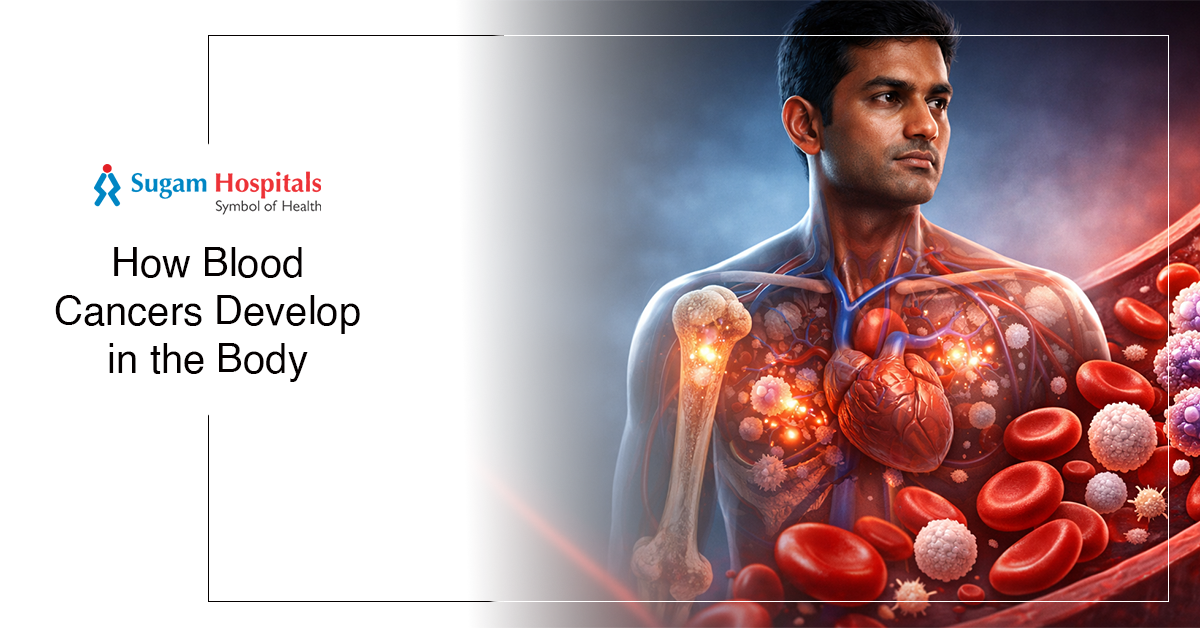
Everything begins in the bone marrow, the soft, spongy tissue inside the cavities of large bones like the pelvis, sternum, and femur. Bone marrow is the body’s blood cell factory. It houses stem cells called hematopoietic stem cells, which have the remarkable ability to divide and differentiate into every type of blood cell the body needs.
From these stem cells, two main lineages emerge. The myeloid lineage produces red blood cells, platelets, and most white blood cells including neutrophils, monocytes, and eosinophils. The lymphoid lineage produces lymphocytes the B cells, T cells, and natural killer cells that form the foundation of the immune response. Every blood cell circulating in the body at this moment traces its origin back to this process, running continuously throughout a person’s lifetime.
When this system works correctly, it is one of the most precisely regulated processes in human biology. When something goes wrong, when a genetic mutation disrupts the normal controls on cell growth and division that precision breaks down. That breakdown is where blood cancer begins.
The Genetic Event That Starts It All
Blood cancer does not develop because of a single bad day in the bone marrow. It begins with a mutation a change in the DNA of a single stem cell or early blood cell that disrupts the normal instructions governing how that cell grows, divides, and eventually dies. Cells are supposed to complete their lifecycle, mature into functional blood cells, and make way for new ones. A mutated cell loses that discipline. It divides without stopping, fails to mature properly, and accumulates in the bone marrow and bloodstream in numbers the body was never designed to accommodate.
What triggers these mutations varies. Some are random errors in DNA replication, the kind that occur simply because cells divide billions of times over a lifetime and mistakes occasionally happen. Others are influenced by:
- Exposure to ionizing radiation over time
- Prolonged contact with certain chemicals, particularly benzene
- Previous chemotherapy or radiation treatment for other cancers
- Inherited genetic syndromes that affect DNA repair mechanisms
- Viral infections in specific cases, such as Epstein-Barr virus in certain lymphomas
In many patients, no single identifiable trigger exists. The mutation happened, the cell escaped normal regulation, and the disease followed. This is important for families to understand blood cancer is not, in most cases, caused by anything the patient did or failed to do.
How the Disease Progresses
Once a mutated cell begins dividing uncontrollably, it produces a clone a population of genetically identical abnormal cells that share the same mutation and the same inability to function normally. This clonal expansion is the central mechanism of blood cancer progression, and it explains why these diseases behave so differently from solid tumors.
Because abnormal cells accumulate in the bone marrow, they crowd out the normal blood-forming cells that belong there. The consequences of this crowding depend on which cell population is being displaced:
- When red blood cell production is suppressed, anaemia develops producing fatigue, breathlessness, and pallor
- When platelet production drops, clotting is impaired leading to easy bruising, prolonged bleeding, and sometimes spontaneous bruising with no injury at all
- When normal white blood cells are displaced, immune function deteriorates leaving the body increasingly vulnerable to infections that a healthy immune system would handle without difficulty
In leukaemia, this process happens primarily in the bone marrow and peripheral blood. In lymphoma, the abnormal lymphocytes accumulate predominantly in lymph nodes and lymphatic tissue. In myeloma, the plasma cells build up in the bone marrow and produce abnormal proteins that damage the kidneys and weaken bone structure over time.
Why Early Detection Changes Everything
The earlier blood cancer is identified, the more treatment options are available, the less damage has been done to normal blood cell production, and the better the overall outcome tends to be. This is where access to a diagnostic centre becomes directly relevant not as a luxury, but as a clinical necessity.
At Sugam Hospital, our diagnostic facilities run around the clock with laboratory capabilities that include full blood count analysis, bone marrow evaluation, flow cytometry for cell typing, and advanced imaging for lymphoma staging. These are not just tests. They are the tools that distinguish one blood cancer from another, determine how far the disease has progressed, and form the foundation of every treatment decision that follows.
Blood cancer develops through a biological sequence that begins at the cellular level, long before any symptom appears. Understanding that sequence, how a single mutated cell becomes a disease that disrupts the entire blood-forming system helps explain why the body’s signals deserve attention even when they seem minor and why waiting for something more dramatic to develop is rarely the right call.
At Sugam Hospital, our oncology team and Best Diagnostic Centre Chennai work together to catch what is developing early, interpret it accurately, and respond with the clinical depth each specific diagnosis demands. Because in blood cancer, what you know early genuinely determines what becomes possible later.