

How Long Does It Take to Die from a Heart Attack?
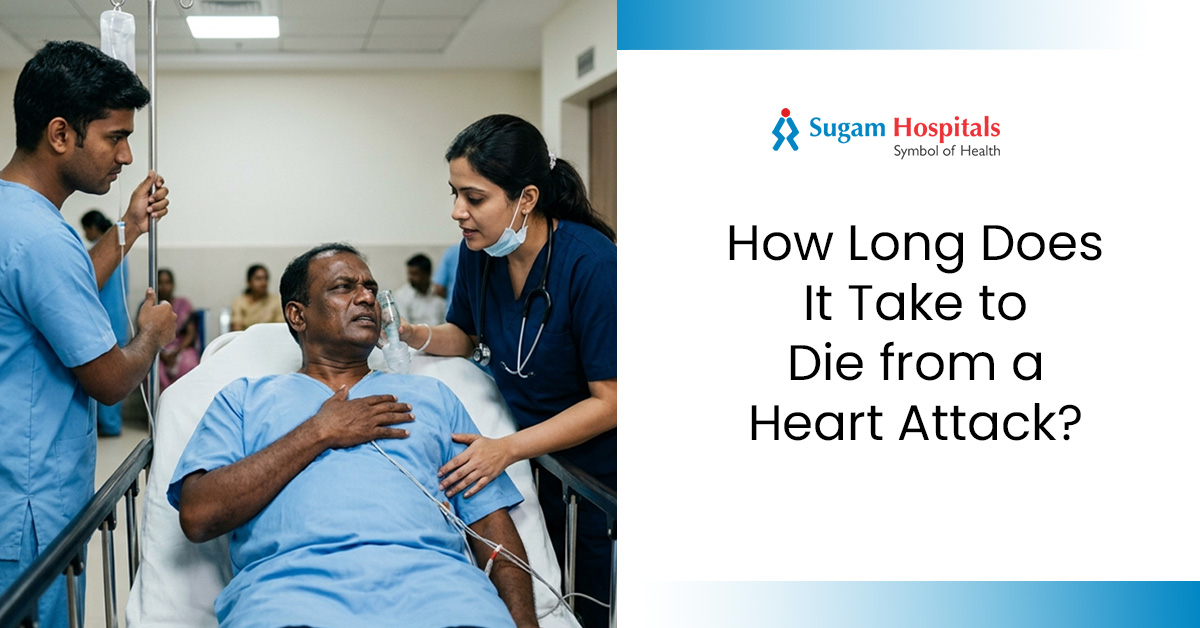
How Long Does It Take to Die from a Heart Attack?
April 8, 2026 by adminIt is a question most people would never type into a search bar under ordinary circumstances. But when someone you love has just had a heart attack, or when you are trying to understand what happened to someone who did not survive one, it becomes the most urgent question in the room. The honest answer is that there is no single number because how a heart attack progresses depends on a combination of biological, circumstantial, and response-time factors that vary enormously from one person to the next.
What does not vary is this: the faster medical intervention arrives, the more of the outcome can be changed. At Sugam Hospital, our best cardiologist doctor in Chennai has seen both ends of that spectrum: patients who survived because someone acted within minutes, and cases where the window closed before help could reach them. Understanding the timeline is not morbid. It is genuinely lifesaving.
What Is Actually Happening During a Heart Attack
A heart attack medically called a myocardial infarction occurs when blood supply to a portion of the heart muscle is blocked, most commonly by a clot forming at the site of a ruptured arterial plaque. The heart muscle supplied by that artery stops receiving oxygen. Within seconds of that cutoff, the affected cells begin to struggle. Within minutes, they begin to die.
The heart is not a passive organ waiting for help. It has its own electrical system, its own compensatory mechanisms, and in some cases, collateral blood vessels that can partially maintain circulation to threatened tissue. These factors buy time but they do not buy unlimited time, and they behave differently in different people depending on the size of the blocked artery, the location of the blockage, the health of surrounding tissue, and whether the person has had previous cardiac events.
The Timeline: What Happens Minute by Minute
This is where biology becomes critically important to understand, because every interval in this sequence has clinical meaning.
Within the first few minutes: the area of heart muscle supplied by the blocked artery loses its oxygen supply. The cells shift to anaerobic metabolism, an emergency backup that cannot sustain normal function. The person typically begins experiencing symptoms at this point, though the character of those symptoms varies more than most people realize.
Between 20 and 40 minutes: irreversible cell death called infarction begins in the most oxygen-deprived tissue at the core of the affected area. This is the point at which permanent heart muscle damage starts accumulating. Every minute beyond this threshold without reperfusion adds to the extent of that damage.
Between one and two hours: if the blockage remains uncleared, the zone of irreversible damage expands outward. Dangerous heart rhythm abnormalities arrhythmias become increasingly likely as the electrical stability of the heart deteriorates. Ventricular fibrillation, where the heart loses its coordinated pumping action entirely, is one of the most common causes of death in this window.
Beyond two hours: the cumulative damage to the heart muscle becomes severe enough that pump function is significantly compromised. Cardiogenic shock where the heart can no longer maintain adequate circulation becomes a real risk, and survival without intensive intervention becomes progressively less likely.
The phrase used in cardiac care “time is muscle” is not a slogan. It is a precise description of what this timeline means: every minute of delay is a measurable quantity of heart muscle that does not survive.
Why Some People Survive and Others Do Not
Several factors influence whether a heart attack proves fatal and over what timeframe:
- Location of the blockage: a blockage in the left anterior descending artery, sometimes called the “widow maker,” cuts off blood supply to a large portion of the heart’s main pumping chamber and is associated with the highest mortality risk
- Time to treatment: patients who receive reperfusion therapy within 90 minutes of symptom onset have dramatically better outcomes than those who arrive later
- Collateral circulation: some people develop alternative blood vessel pathways over time, particularly those with longstanding coronary artery disease, which can partially protect threatened tissue
- Whether a dangerous arrhythmia develops: ventricular fibrillation can be fatal within minutes but is reversible with immediate defibrillation
- The person’s baseline cardiac health: a previously healthy heart tolerates an acute event differently than one already weakened by previous damage or chronic disease
The Symptoms That Are Being Ignored
One of the most consistent findings in cardiac research is that people wait too long before calling for help. The average delay between symptom onset and hospital arrival remains over two hours in many studies a window in which enormous amounts of heart muscle are being lost.
Symptoms that should trigger an immediate emergency response include:
- Chest pain, pressure, tightness, or heaviness that lasts more than a few minutes or comes and goes
- Pain or discomfort radiating to the arm, jaw, neck, or back
- Sudden breathlessness with or without chest discomfort
- Cold sweats, nausea, or lightheadedness arriving without obvious cause
- An unusual sense of dread or impending doom a symptom that sounds vague but is reported frequently and should never be dismissed
Women, in particular, are more likely to experience atypical symptoms breathlessness, fatigue, nausea, and jaw pain rather than the classic chest pressure. These presentations get attributed to anxiety or indigestion far too often, and the delay that follows is genuinely dangerous.
What Happens When Help Arrives Quickly
This is the part of the story that deserves equal emphasis. A heart attack does not have to be fatal. With rapid reperfusion either through clot-dissolving medication or emergency angioplasty to physically reopen the blocked artery the damage can be limited, the rhythm stabilized, and the heart given a genuine chance at meaningful recovery.
At Sugam Hospital, our Cardiologist team is structured specifically around speed. From the moment a patient presenting with a possible heart attack arrives, the pathway to diagnosis and intervention is direct, coordinated, and measured in minutes rather than hours because that is the only timeframe that matters when the heart muscle is under threat.
There is no comfortable answer to how long a heart attack takes to become fatal. The range spans from minutes to hours depending on factors that cannot always be predicted. What can be controlled is the response how quickly symptoms are recognized, how fast emergency services are called, and how rapidly definitive treatment begins. That response time is the variable with the most direct influence on whether someone survives, how much heart function they retain, and what their life looks like afterward. Do not wait for certainty before calling for help. In a heart attack, certainty comes too late.