

Robotic Surgery vs. Open Surgery: Which One Should You Choose in 2026?
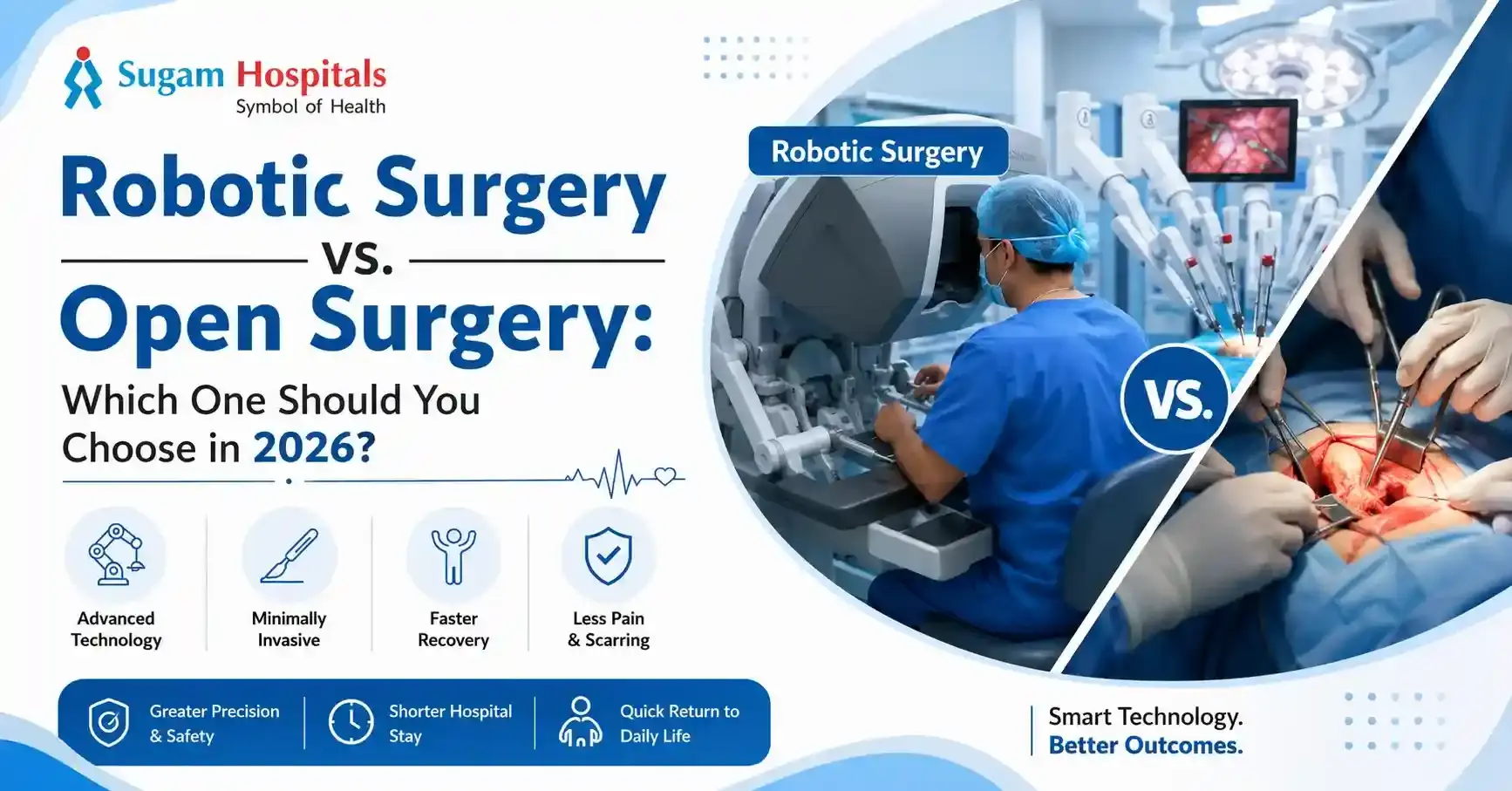
Robotic Surgery vs. Open Surgery: Which One Should You Choose in 2026?
July 13, 2026 by adminRobotic surgery uses tiny incisions, a 3D magnified camera, and robotic arms controlled entirely by your surgeon, resulting in less pain, less blood loss, and a faster return to daily life. Open surgery uses one larger incision and remains the better – sometimes the only – choice for emergencies, very large tumors, or complex anatomy where a surgeon’s hands and direct view matter most. At Sugam Hospital, our surgical team evaluates your specific condition, health history, and anatomy before recommending either approach, because the “best” surgery is the one that’s right for your body, not a one-size-fits-all answer.
Is Robotic Surgery Actually Done by a Robot?
No – and this is the single most common misunderstanding patients bring to their consultation at Sugam Hospital. A robot does not operate on its own. Your surgeon sits at a console a few feet from the operating table and controls every single movement of the robotic arms in real time. Think of it less like an autonomous machine and more like a highly precise extension of the surgeon’s own hands – every cut, stitch, and movement still comes from human judgment and training. The robot simply removes hand tremor, adds a magnified 3D view, and allows movement in tighter spaces than human wrists can reach.
Key Differences Between Robotic and Traditional Surgery
How is a robotic surgery different from a traditional one?
The difference comes down to three things: incision size, visualization, and control.
| Factor | Robotic Surgery | Open (Traditional) Surgery |
| Incision size | Few small (1–2 cm) ports | One larger incision (3–10+ inches) |
| Surgeon’s view | 3D, high-definition, magnified up to 10x | Direct naked-eye view |
| Instrument movement | Wristed arms with 360° rotation | Limited to human hand/wrist range |
| Blood loss | Typically minimal | Generally higher |
| Hospital stay | Often 1–3 days | Often 5–10 days depending on procedure |
| Scarring | Minimal, small dot-like scars | Visible linear scar |
| Best suited for | Localized, anatomically accessible conditions | Emergencies, very large or complex cases |
Does robotic surgery cost more than open surgery?
Generally, yes. Robotic-assisted procedures at most hospitals, including Sugam Hospital, carry a higher upfront cost due to the technology and specialized equipment involved. However, many patients offset this with shorter hospital stays, fewer follow-up complications, and quicker return to work – costs that add up with open surgery’s longer recovery window. Our team will walk you through a transparent cost estimate during your consultation, including what your insurance may cover.
Recovery Timelines Differ
How long does it take to recover from robotic surgery vs. open surgery?
This is usually the deciding question for most patients, and rightly so.
- Robotic surgery recovery: Most patients are up and walking within hours, discharged in 1–3 days, and back to light daily activity within 1–2 weeks. Because the abdominal wall and muscles aren’t cut open, internal healing is faster and post-operative pain is significantly lower.
- Open surgery recovery: Expect a hospital stay of 5–10 days depending on the procedure, followed by 4–8 weeks (sometimes longer) before returning to normal activity. The larger incision means more tissue trauma, which translates to more pain medication, a higher infection risk, and a slower return to work or exercise.
Key takeaway: If your condition qualifies for both approaches, robotic surgery generally means less time in the hospital and less time away from your life. But qualification depends entirely on your specific case – not personal preference alone.
Benefits of Robotic Surgery
What are the real advantages patients notice?
- Smaller incisions — often just a few millimeters wide, leading to minimal scarring
- Reduced blood loss — lowering the chances of needing a transfusion
- Lower infection risk — smaller wounds mean fewer entry points for bacteria
- Less post-operative pain — many patients need fewer painkillers
- Greater surgical precision — the robotic wrist rotates further than a human hand, reaching tight or awkward anatomical spaces
- Shorter hospital stay — freeing up recovery time at home
- Faster return to routine — work, exercise, and family life resume sooner
Are there any downsides to robotic surgery?
Yes, and an honest answer matters here. Robotic surgery isn’t automatically better for every patient or every condition. It can cost more, isn’t available for certain emergency or highly complex cases, and requires a surgeon specifically trained on the robotic system. Not every hospital or every surgeon offers it – which is why choosing a center with proven robotic surgery experience, like Sugam Hospital, matters as much as choosing the technique itself.
How the Robot Works
What actually happens in the operating room?
- Surgeon at the console: Your surgeon sits at a 3D high-definition console a short distance from you, viewing a magnified image of the surgical area.
- Robotic arms at the table: A separate unit with 3–4 robotic arms holds miniature surgical instruments and a camera, inserted through small incisions.
- Real-time hand movement translation: Every movement of the surgeon’s hands is translated instantly and precisely into the robotic instruments — scaled down and tremor-filtered for accuracy.
- Continuous surgeon control: The system cannot move or act independently; if the surgeon’s hands stop, the instruments stop. There is no autonomous operation at any stage.
- Assisting team present throughout: A full surgical team, including an assistant surgeon at the table, remains present for the entire procedure, ready to intervene manually if ever needed.
Can the surgeon lose control of the robot?
No. The system is designed with multiple safety overrides, and the surgeon can pause or stop instantly at any point.
What Can Robotic Surgery Be Used For?
Robotic-assisted techniques have expanded well beyond a single specialty. At Sugam Hospital, our robotic surgery program supports a wide range of departments:
Urologic Robotic Surgery
Used for prostate removal (radical prostatectomy), kidney tumor removal, kidney reconstruction, and bladder procedures. The pelvis is a tight, nerve-dense area where robotic precision helps protect surrounding nerves responsible for continence and sexual function — something far harder to preserve with open surgery.
Gynecological Robotic Surgery
Applied for hysterectomy, fibroid removal (myomectomy), endometriosis treatment, and certain gynecologic cancer surgeries. Smaller incisions mean less scarring and a faster return to normal activity – a meaningful factor for women balancing recovery with work and family responsibilities.
Colorectal Robotic Surgery
Used for colon and rectal cancer resections, especially in the narrow, hard-to-access pelvic region. The robotic wrist’s extended range of motion allows surgeons to operate deep in the pelvis with a level of precision that’s difficult to achieve through an open incision.
Cardiac Robotic Surgery
Applied in select mitral valve repairs and certain coronary procedures. Because the chest doesn’t need to be fully opened, patients often experience less post-operative pain and a shorter recovery than with traditional open-heart surgery – though eligibility depends heavily on the specific cardiac condition.
General Surgery
Covers hernia repair, gallbladder removal (cholecystectomy), and select gastrointestinal procedures. Even routine surgeries benefit from smaller scars and quicker recovery when performed robotically.
Don’t forget this: not every case within these specialties qualifies for a robotic approach. Tumor size, prior surgeries, scar tissue, and overall health all factor into your surgeon’s recommendation.
When Is Traditional Surgery Needed?
Does open surgery still have a place in modern medicine?
Absolutely – and it isn’t a “last resort.” Open surgery remains the necessary and preferred choice in several situations:
- True medical emergencies, such as trauma or active internal bleeding, where every second counts and there’s no time to set up robotic equipment
- Very large tumors or masses that are too big to remove safely through small incisions
- Extensive scar tissue from previous surgeries that limits access for robotic instruments
- Complex reconstructive or transplant procedures requiring direct tactile feedback that current robotic systems can’t fully replicate
- Certain high-risk patients where a faster, more direct surgical approach reduces overall procedure time and anesthesia exposure
In these situations, a surgeon’s direct hands-on access and unobstructed view genuinely provide the safer outcome. Sugam Hospital’s surgical team will always recommend open surgery when it is medically the better option – never robotic surgery simply because the technology is available.
Robotic Surgery vs. Open Surgery: How to Decide
There’s no universal “better” option – only the option that’s better for your specific diagnosis, anatomy, and health history. Here’s a simple way to think about it:
- Choose based on your condition first, not the technique. Ask your surgeon which conditions in your case make you eligible for either approach.
- Consider your recovery goals. If returning to work or family responsibilities quickly matters most, and you qualify medically, robotic surgery may align better.
- Consider urgency. If your situation is an emergency, open surgery is very likely the immediate and correct choice.
- Ask about surgeon experience. A highly skilled surgeon performing open surgery will always outperform a poorly matched robotic case. Technique matters less than expertise and appropriateness.
At Sugam Hospital, our surgeons discuss both pathways honestly during consultation, including risks, costs, and expected recovery – so you’re deciding with complete information, not marketing.
Conclusion
Robotic and open surgery aren’t competitors – they’re two different tools suited to different situations. Robotic surgery generally offers smaller incisions, less pain, and faster recovery for eligible cases, while open surgery remains essential for emergencies and complex, large-scale procedures. The right choice depends entirely on your diagnosis, anatomy, and health history, not personal preference or trend.
At Sugam Hospital, our surgical specialists across urology, gynecology, colorectal, cardiac, and general surgery evaluate every case individually – combining advanced robotic technology with decades of hands-on surgical expertise to recommend the approach that gives you the safest, fastest path to recovery.
Frequently Asked Questions
For eligible cases, robotic surgery generally carries lower risks of infection, blood loss, and complications due to smaller incisions. However, "safer" always depends on whether your specific condition is medically suited to the robotic approach — which only a qualified surgeon can determine after examination.
Robotic surgery typically uses incisions of about 1-2 centimeters, compared to open surgery incisions that can range from 3 to over 10 inches depending on the procedure.
Most patients report significantly less post-operative pain after robotic surgery because the abdominal muscles and tissue aren't cut open the way they are in open surgery. Pain medication needs are typically lower as well.
Yes. Robotic techniques are widely used in urologic, gynecologic, and colorectal cancer surgeries at Sugam Hospital, often allowing for precise tumor removal while preserving surrounding healthy tissue and nerves.
Eligibility depends on factors like tumor size and location, prior surgical history, overall health, and the specific condition being treated. A consultation with a Sugam Hospital surgeon, including imaging and health assessment, is the only reliable way to determine candidacy.
No. Open surgery remains essential for emergencies, very large or complex cases, and situations requiring direct tactile assessment. It is a different tool for different circumstances - not an outdated one.
Coverage varies by insurer and policy. Sugam Hospital's patient care team can help verify your coverage and provide a clear cost breakdown before your procedure.