

How Screen Time Affects Child Development
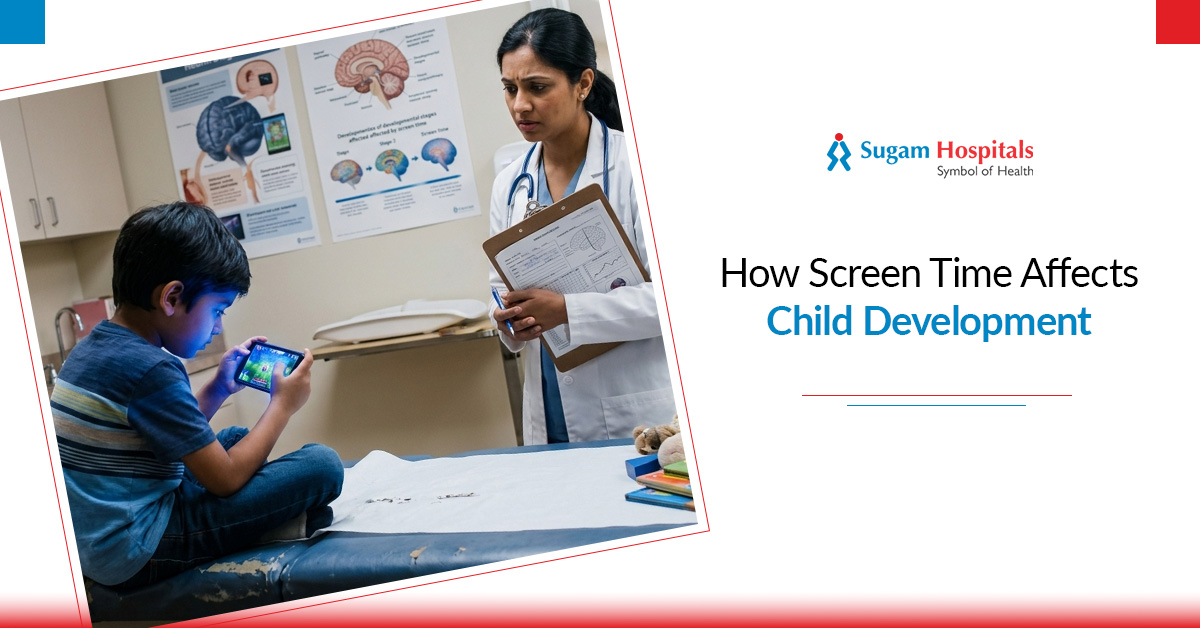
How Screen Time Affects Child Development
April 23, 2026 by adminThere is not a parent alive right now who has not had some version of the screen time conversation either with their child, their partner, or quietly with themselves at the end of a long day when handing over a tablet felt like the only realistic option. The guilt that follows is real, but so is the confusion. Every week seems to bring a new headline screens are destroying attention spans, screens are educational tools, two hours is fine, any amount is harmful. It is genuinely hard to know what to believe.
At Sugam Hospital, recognized as a trusted pregnancy hospital in Chennai and a dedicated center for child health, we think parents deserve a clearer, more honest picture one that goes beyond headlines and reflects what the research actually shows about how screens shape developing minds and bodies.
Why Developing Brains Are Particularly Vulnerable
A child’s brain is not a smaller version of an adult brain. It is a brain in an active, time-sensitive process of construction building neural pathways, developing language circuits, forming the capacity for emotional regulation, and establishing the foundational skills that will underpin learning and relationships for the rest of that child’s life. The experiences a child has during this window shape that construction in ways that are difficult to reverse later.
This is why screen time is not a neutral variable. It is an experience one that either supports or competes with the developmental inputs the brain needs during these critical years. The question is not simply how much screen time a child is getting. It is what that screen time is replacing, and what it is doing to the developing nervous system in the process.
What the Research Actually Shows
The evidence on screen time and child development is more nuanced than most public conversations suggest and that nuance matters for how parents approach it practically.
In children under 18 months, the research is fairly consistent: passive screen consumption — videos, shows, scrolling content does not produce learning in the way real-world interaction does. Infants learn language, social cues, and emotional understanding through face-to-face engagement with caregivers. A screen cannot replicate the contingent, responsive interaction that drives early brain development. Video calls are a meaningful exception, because they involve real-time social interaction but background television and passive content do not carry the same value.
Between ages two and five, the picture becomes more contextual. High-quality, slow-paced, educational content, the kind designed with developmental input can support vocabulary and early learning when watched with a caregiver who engages with the content alongside the child. Passive consumption of fast-paced entertainment content, particularly for extended periods, is associated with reduced attention span and language development in this age group.
In school-age children, the concerns shift:
- Excessive recreational screen time is consistently linked to reduced sleep quality, which affects memory consolidation, emotional regulation, and academic performance
- Displacement of physical activity by sedentary screen use has implications for motor development, cardiovascular health, and social skill-building
- Social media and unmoderated internet content in older children carry their own developmental and psychological risks that are distinct from earlier screen concerns
- Passive consumption versus active creation on screens produces meaningfully different cognitive outcomes, a child coding, drawing digitally, or engaging with interactive educational content is using their brain very differently from one passively watching videos
Sleep: The Most Underestimated Consequence
If there is one area where the evidence against excessive screen time is particularly strong, it is sleep. Screens emit blue light that suppresses melatonin production, the hormone that signals the brain to prepare for sleep. Evening screen use, even for relatively short periods, delays sleep onset and reduces total sleep time. In children, whose brains are consolidating enormous amounts of learning during sleep, that disruption carries real developmental costs.
Children who consistently sleep less than recommended for their age show measurable differences in attention, emotional regulation, and memory compared to well-rested peers. When screen use is identified as the primary driver of sleep disruption, addressing it directly is one of the highest-impact interventions a parent can make.
What Healthy Screen Use Actually Looks Like
The goal is not zero screens, that is neither realistic nor, for older children, necessarily desirable. The goal is intentional use that does not crowd out the experiences children genuinely need.
Practical markers of healthy screen use include:
- Screens are not the first activity of the morning or the last before bed
- Screen time does not consistently replace outdoor play, physical activity, or face-to-face social interaction
- Content is age-appropriate, relatively slow-paced, and where possible watched together rather than in isolation
- Total daily recreational screen time for school-age children stays within two hours outside of educational use
- Devices are absent from mealtimes and the hour before sleep
None of these are rigid rules that apply identically to every child and every family. They are principles and the degree to which they are relevant depends on the child’s age, temperament, and what the screen time is actually replacing in their day.
Screen time is not a parenting failure or a modern catastrophe. It is a variable one that can be managed in ways that protect development or neglected in ways that gradually undermine it. The families who navigate it best are not the ones who eliminate screens entirely. They are the ones who stay curious about what their child is watching, stay engaged in how screens fit into the broader texture of their child’s day, and stay willing to adjust when the balance shifts in the wrong direction.
At Sugam Hospital, our best pediatric hospital in Chennai team supports families through exactly these conversations because child development is not just about what happens at a clinical appointment. It is about what happens every day, in the small decisions that accumulate into the environment a child grows up in.