

How Sports and Accidents Lead to Bone Dislocations
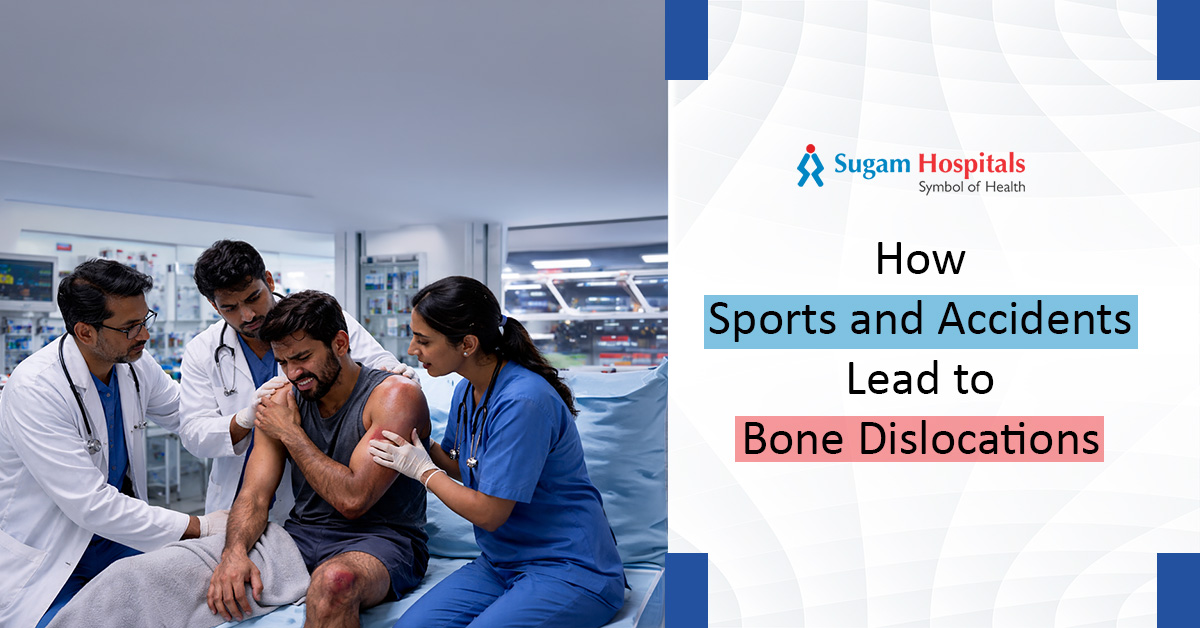
How Sports and Accidents Lead to Bone Dislocations
March 24, 2026 by adminThere is a particular kind of pain that comes with a dislocation sharp, immediate, and accompanied by the deeply unsettling feeling that something has shifted in a way it clearly should not have. It is not a sprain. It is not a fracture. It is the moment when the bones forming a joint are forced out of their normal position, and the body makes absolutely sure you know about it. Whether it happens on a football field, during a road accident, or in a fall that goes wrong in a split second, dislocations demand prompt, skilled attention.
Trying to manage one without proper clinical assessment can turn a recoverable injury into something you are still dealing with years later. At Sugam Hospital, our Ortho Doctor understands exactly what that moment costs a person and we are ready to respond with the speed and precision it deserves.
What a Dislocation Actually Is
A joint is where two or more bones meet. Ligaments, cartilage, and surrounding soft tissue hold everything in position and allow movement within its intended range. A dislocation happens when a sudden, forceful impact drives those bones out of alignment. The joint no longer sits where it should. Surrounding tissue stretches, tears, or gets compressed — and the body responds immediately with pain, swelling, and loss of normal movement.
The signs are usually hard to ignore:
- Immediate, intense pain at the joint
- Visible deformity, the area looks clearly out of place
- Rapid swelling and bruising around the site
- Near-complete loss of movement in the affected limb
- Numbness or tingling if nearby nerves are involved
What makes dislocations particularly serious is that they rarely arrive alone. The same force that displaces a joint frequently damages surrounding nerves, blood vessels, and ligaments. This is why a dislocation needs proper evaluation before any treatment begins not a quick fix.
How Sports Create the Conditions for Dislocation
Sport places the body under controlled stress and occasionally, completely uncontrolled stress. Contact sports like football, rugby, and kabaddi generate high-impact collisions where a joint can be driven beyond its normal range in a fraction of a second. A shoulder tackled from the wrong angle, a knee twisted under body weight, a finger jammed hard against another player — these are not freak accidents. They are predictable consequences of what these sports physically demand.
In sports like gymnastics, basketball, and volleyball, rapid directional changes and awkward landings place ligaments under cumulative stress. A joint that has been strained repeatedly becomes progressively less stable and a less stable joint does not need much of a wrong movement to give way completely.
Shoulder dislocations deserve a specific mention. The shoulder is the most mobile joint in the body, which is precisely what makes it the most vulnerable. A single dislocation particularly in a young or active person carries a high risk of recurring if rehabilitation is skipped or rushed. Many people return to sport feeling fine, skip the structured follow-through, and end up back in the same situation within months. That pattern is entirely preventable with the right care the first time.
How Accidents Produce Dislocations
Road accidents and workplace injuries work through a completely different mechanism sudden, high-energy trauma applied to a body with no time to prepare. Hip dislocations are almost exclusively seen following vehicle accidents, where force travels up through the femur and drives the thighbone out of the hip socket almost instantaneously.
Falls from height produce elbow and wrist dislocations when the instinct to break a fall transfers enormous force through joints not designed to absorb impact in that direction. Workplace accidents involving machinery or falling objects can affect joints that sporting injuries rarely touch.
What sets accident-related dislocations apart is what tends to accompany them:
- Fractures at or near the dislocated joint
- Blood vessel damage affecting circulation to the limb
- Nerve injuries producing numbness or weakness
- Significant ligament rupture affecting long-term stability
This is exactly why imaging is non-negotiable before any reduction procedure begins.
What Happens When Treatment Is Delayed
A dislocated joint that is not properly reduced within an appropriate time window creates problems that compound quickly. The longer the displacement continues, the higher the risk of avascular necrosis where blood supply to the bone is compromised and tissue begins to break down. Nerve damage that was initially reversible becomes permanent. Muscles surrounding the joint go into protective spasm, making reduction progressively harder.
Over time, inadequately treated dislocations lead to chronic instability, accelerated arthritis, and a significantly elevated risk of re-dislocation. What should have been a complete recovery becomes a long-term management problem and almost all of it was avoidable.
What Treatment at Sugam Actually Looks Like
At Sugam Hospital, we begin with assessment not assumption. Imaging confirms the displacement. Neurovascular status is evaluated before any manipulation is attempted. Reduction is performed by our Ortho Doctors under proper pain management, carefully and only once the full clinical picture is understood.
Post-reduction recovery is where outcomes are genuinely decided. A structured rehabilitation plan typically includes immobilization, physiotherapy focused on rebuilding joint stability, and a graduated return to activity based on actual progress not just how the patient feels on a good day. For athletes, recovery is built around the real demands of their sport, because getting back on the field and being truly ready for it are two very different things.
Dislocations can feel deceptively short-lived once the acute pain fades. People assume the worst is behind them and skip the follow-through. That is exactly where long-term damage quietly begins. Whether the injury happened during a match or on a road, the quality of care in the weeks that follow shapes everything about what that joint looks like years from now. At Sugam Hospital, our best ortho doctor in Chennai is committed to getting that right from the first assessment to the last physiotherapy session. Treated properly once, it rarely becomes a problem you keep coming back for.