

Types of Kidney Stones and What They Mean
Types of Kidney Stones and What They Mean
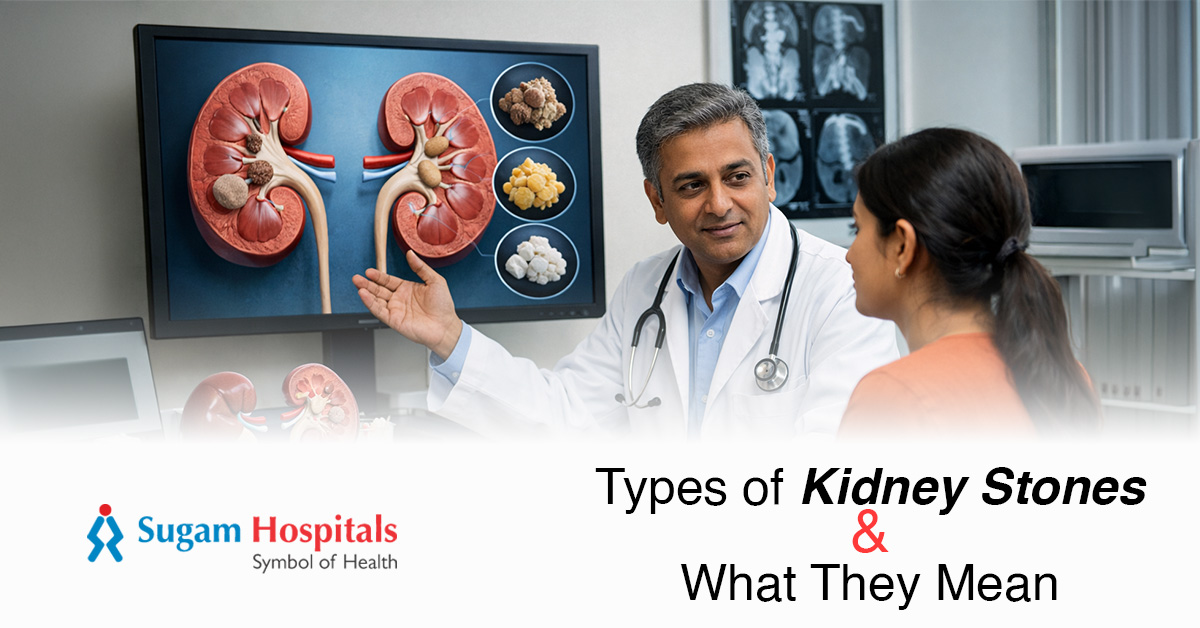
March 24, 2026 by adminAnyone who has had a kidney stone will tell you it is not something they would wish on another person. The pain arrives suddenly, severely, and in a way that is hard to describe until you have been through it yourself. But here is what most people do not realize not all kidney stones are the same. They form through different mechanisms, for different reasons, and what works to treat or prevent one type can be completely ineffective for another. Knowing which type of stone you have is not a minor detail. It is the entire foundation of a management plan that actually holds up over time. At Sugam Hospital, our Kidney Stone Specialist in Chennai approaches every case with that specificity because generic advice rarely stops a stone from coming back.
Why Kidney Stones Form in the First Place
Before getting into the types, the basic process is worth understanding. Urine contains dissolved minerals and salts. When the concentration of certain substances rises too high because of dehydration, diet, metabolic conditions, or a combination of all three they stop dissolving and begin to crystallize. Those crystals accumulate, bind together, and gradually form a stone. Small ones pass on their own, painfully. Larger ones do not, and that is when intervention becomes necessary.
The composition of the stone what it is actually made of depends on which substances crystallized. That composition tells a clinician far more than the stone’s size or location. It tells them why the stone formed, and that is the question that matters most when it comes to preventing the next one.
Calcium Oxalate Stones: The Most Common Type
The majority of kidney stones roughly 70 to 80 percent are made of calcium oxalate. This surprises people who immediately assume that cutting back on calcium will help. In most cases, it does the opposite. Dietary calcium binds to oxalate in the gut and stops it from being absorbed into the bloodstream. When calcium intake drops, more oxalate gets absorbed, reaches the kidneys in higher concentrations, and increases stone risk.
What actually contributes to calcium oxalate stones includes:
- A diet consistently high in oxalate-rich foods, spinach, nuts, chocolate, and certain teas
- Chronically low fluid intake leading to concentrated urine
- A tendency to absorb oxalate from the gut more readily than average a metabolic pattern rather than purely a dietary one
- Low urinary citrate levels, which normally inhibit crystal formation
Identifying which of these factors is driving stone formation in a specific person is exactly what a thorough evaluation achieves and it is what separates a plan that works from one that simply sounds reasonable.
Calcium Phosphate Stones
Calcium phosphate stones form in urine that is consistently more alkaline than it should be. They are frequently associated with renal tubular acidosis a condition where the kidneys fail to properly acidify urine and with long-term use of certain medications, including some carbonic anhydrase inhibitors prescribed for glaucoma or epilepsy.
These stones are worth distinguishing from calcium oxalate stones because the metabolic drivers are different, and the prevention strategies follow directly from those differences. A stone analysis identifying calcium phosphate as the primary component should prompt investigation into underlying causes rather than dietary changes alone.
Uric Acid Stones: Diet and Metabolism Working Together
Uric acid stones form when urine is persistently acidic and uric acid concentration is elevated. They are strongly linked to a high-purine diet red meat, organ meat, shellfish and to conditions like gout, type 2 diabetes, and metabolic syndrome. People carrying significant excess weight tend to produce more acidic urine, which creates exactly the environment uric acid needs to crystallize.
One clinically important feature of uric acid stones is that they are radiolucent, they do not appear on a standard X-ray the way calcium stones do. A CT scan is required to detect them reliably. This matters because a patient told they have no stones based on an X-ray alone may still have a uric acid stone driving their symptoms.
Uric acid stones are also among the most treatable without surgery. Alkalinizing the urine with potassium citrate and addressing the underlying metabolic contributors can actually dissolve existing stones something not possible with calcium-based stones.
Struvite Stones: Directly Linked to Infection
Struvite stones form as a direct consequence of urinary tract infections caused by specific bacteria particularly those that produce an enzyme called urease, which breaks down urea and raises urinary pH rapidly. The resulting alkaline environment allows magnesium, ammonium, and phosphate to crystallize quickly, sometimes producing large stones that fill the entire kidney’s collecting system, known as staghorn calculi.
These stones tend to affect:
- Women, given the higher frequency of urinary tract infections overall
- People with structural abnormalities in the urinary tract that make infections more persistent
- Those with long-term catheter use or recurrent hospitalizations involving urinary procedures
Treatment involves complete stone removal leaving fragments behind allows the infection to persist and new growth to continue combined with targeted antibiotic therapy. Our Urology Specialist team at Sugam Hospital manages these cases with both the stone burden and the underlying infection addressed simultaneously, because treating one without the other simply does not hold.
Cystine Stones: A Genetic Condition
Cystine stones are the least common type and the most clearly genetic in origin. They form in people who inherit a condition called cystinuria, where the kidneys excrete abnormally high amounts of cystine into urine. Cystine is poorly soluble, and at high concentrations it crystallizes readily and persistently.
These stones tend to recur throughout a person’s life. Management is long-term and specific high fluid intake, urine alkalinization, and in some cases medications that bind cystine and increase its solubility. Identifying cystine as the stone type early in a young patient changes the entire management trajectory, because the approach is lifelong and cannot be treated the same way as any other stone type.
Every kidney stone has a story behind it a specific mix of metabolic, dietary, genetic, or infectious factors that created the right conditions for it to form. Removing the stone without reading that story means the next one is quietly already on its way. At Sugam Hospital, our Urology Specialist team does not stop at clearing the stone. We investigate why it formed, confirm what type it is, and work with each patient on what actually needs to change going forward because that is the part of kidney stone care that makes a real, lasting difference.